TERA Gallery - African Art and Antiquities "Altering The Way You View The World Of Art" |

Type of Object:
Ethnic Group:
Reference:
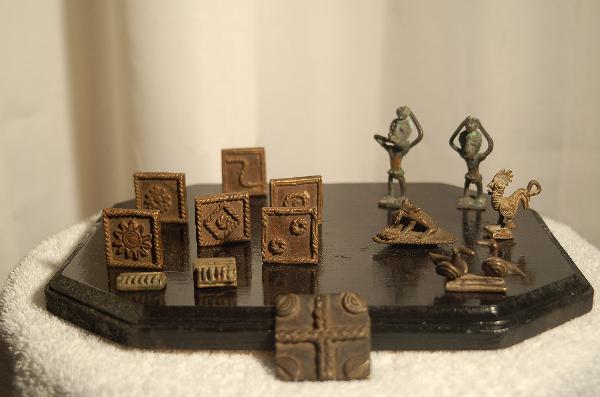
- Asante Goldweights
- Gold weights have been called "masterpieces in miniature"
reflecting artistry in service to commerce. The weights are
not gold but were used in the trade of gold.
Until the end of the nineteenth century, gold (sika) was the
currency of the Asante, Fante, Baule and other Akan
peoples of Ghana. Used in trade with European merchants
along the Ivory coast or Islamic traders from the north, gold
dust was measured on small scales called ‘‘nsania’’ using
small copper, bronze or brass sculpted weights known as
‘‘abrammo’’. Most people engaging in trade owned a set of
weights ranging in appearance from small geometrically
patterned weights to complex figurative and
representational weights.
- Evidence of early West African gold trade was located 8th
and 9th century European and Islamic records that refer to
the ancient Kingdom of Ghana as the “Land of Gold”.
Throughout the centuries Egyptian, Roman, and Islamic
weights were used (respectively) in the gold trade as each
new wave of foreign traders brought their own measurement
system, the most important of these systems being the
Portuguese and Dutch. Beginning as early as 1400, the
northern Akan created their own weighted system for
measuring gold. The Akan weights were established on a
combination of the Islamic, Portuguese, and English
systems. The Ashanti, often called the Asante, were among
the last to undertake weight production, beginning in the
very early 1700’s. Use of the Akan weights had ended by
the onset of the 20th century.
Cast in the ‘‘lost-wax’’ technique these small sculptures
served to facilitate trade while depicting Akan values
characterized through proverbs or popular sayings. Weights
would carry traditional proverbial lore or simply show people
in everyday activity or comment upon social and political
relationships, or to reflect upon religious acts and spiritual
ideals. Humans, animals, fish, amphibians as well as
objects of everyday life were apt subject for representation
in weights.
Representational imagery derived from contact with
Europeans includes ships, rifles and cannon are also found
in weights. Gold weights are some of the best known
examples of Akan arts reflecting their artistry in small scale
but carrying great meaning.
The Lost Wax Method is an exceptionally labor intensive
process where a wax mold is formed by hand over an open
fire until mold is exactly as intended.
Ethnic Group:
- Asante Society
- Bronze
Brass
Copper
Reference: