TERA Gallery - African Art and Antiquities "Altering The Way You View The World Of Art" |

Type of Object:
Ethnic Group:
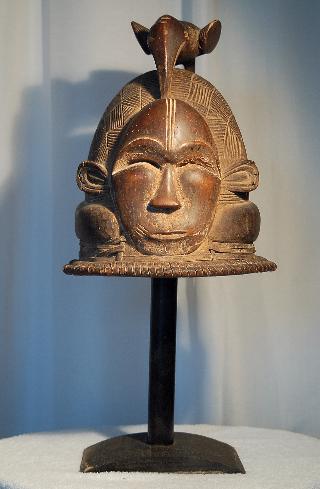
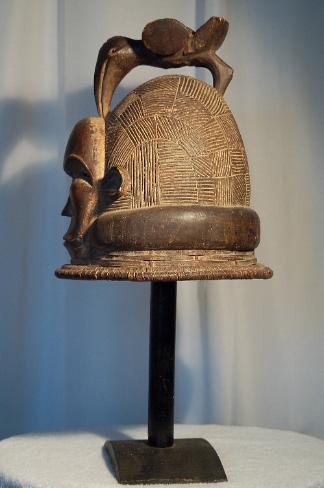
- Bundu Helmet Mask
20th. c
- The Mende are best known for smooth, black, helmet-
shaped masks, named sowei, used by the Sande society, in
particular, during the initiating girls. The initiates learn
wisdom, beauty, grace, and self-control, all of which they will
need within the multigenerational, polygamous households
of their future husbands.
- All Mende girls join the Sande society at puberty.
Representing female water spirits, the masks have an
idealized female face whose aesthetic reflects religious and
philosophical ideals. The design of the facial features
conforms to strict conventions and has symbolic content.
- These masks are characterized by the shiny skin, the rings
at the neck and the elaborate hair styling that suggest good
health and a well-to-do social condition. The characteristic
rings at the base of the masks can be explained as the
concentric ripples created as the spirit emerges from the
water. On the other hand, they are also believed to
represent folds of fat, considered a sign of beauty, fertility,
vitality, and health.
- The coiffures, on the other hand, display a great range of
variations, which reflect changing fashions and thus may
facilitate the dating and localization of the masks. These
helmets were carved from the full trunk of a large tree.
- Sowei appears in public during the time when young girls
are initiated into adulthood. It may also emerge at the
crowning of or during the funeral ceremonies of a paramount
chief. The masks are carved by men, but danced by women.
This is unusual in Africa, since men usually wear masks that
conceal the face. They were worn over the head with the rim
resting on the shoulders. There are helmets with one, two, or
four faces.
- Because the mask is "found" beside a stream deep in the
forest, where the Sande spirit is said to live, and is
supposed not to be an artifact at all, the carver in this case
is anonymous. The dancer takes care that her costume
contain no opening other than a narrow slit for the eyes, not
to come into contact with the spirit, which she imagines as
possessing a fearful, all-consuming power.
Ethnic Group:
- Mende Society
- Sierra Leone and Liberia
- Wood
- 16 1/2"H x 9 1/2"W x 9 1/2"D