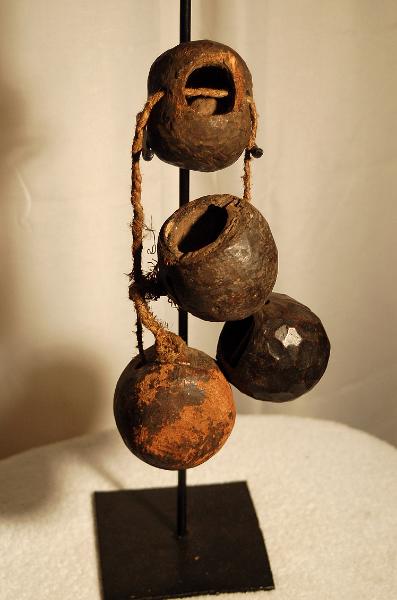
TERA Gallery - African Art and Antiquities "Altering The Way You View The World Of Art" |

Type of Object:
Ethnic Group:
Material:
Dimensions:
Reference:
- Hunting Dog Bells
19th c.
- These beautifully crafted wooden bells are never seen
in art collections.
- These bells were first noted in the early 1900's by Dr.
William Henry Sheppard (1865 – 1927) who was one
of the earliest African-Americans to become a
missionary for the Presbyterian Church, he spent from
1890 until 1910 in Africa, primarily in and around the
Congo Free State, and is best known for his efforts in
publicizing the atrocities committed against the Kuba
and other Congolese peoples by King Leopold II's
Force Publique. Although Dr. Sheppard's efforts
contributed to the contemporary debate on European
colonialism and imperialism in the region, particularly
amongst those of the African American community, he
received little attention in literature on the subject .
- By the 1870s Hampton University in Hampton,
Virginia had established an African studies program,
and in 1911 the school acquired the William H.
Sheppard Collection of African Art – several hundred
superb pieces gathered by Hampton alumnus William
Sheppard. Not only was Sheppard the first westerner
to enter the Kuba Kingdom, he was first African
American to collect African art in the late 19th and
early 20th centuries. His contribution to Hampton
University Museum’s collections gives it the oldest
collection of Kuba-related material in the world.
- According to Dr. Sheppard in his reports about the
dog that could not bark, the Besenji, he noted that the
dog owners when hunting would tied wooden bells
with wooden clappers around their necks because
each bell sounded different than the others allowing
the owners to identify their own dog by the sound of
the bells.
- These art objects have a beautiful patina, and no two
bells are the same.
TERA Gallery is proud to recognize the distinguish
and historic contributions of Dr. Sheppard and the
artistic genius of the African people.
- This object is curently being studied in the TERA
Gallery Reading Room.
Ethnic Group:
Material:
Dimensions:
Reference: