TERA Gallery - African Art and Antiquities "Altering The Way You View The World Of Art" |

Type of Object:
Ethnic Group:
Material:
Dimensions:
- Ekonda Currency
17th c.
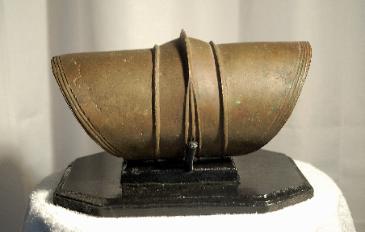
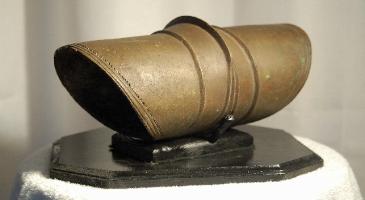
- This very old impressive legband is perhaps the the most
famous of African currency. It is a wonderful five ribbed
bronze ankle cuff currency bracelet created from solid
bronze and loaded with a beautiful patina. Note the
matching carved design on the extended edges that was
intended to meet when the cuff was worn closed,
The technique with which Mongo smiths fashioned these
heavy women’s leg bands (which, especially among the
neighboring Kunda, also served as currency), has been
described as follows: an ingot fusing copper and zinc was
formed with great heat in a horizontal press molded in the
earth. Still red hot and malleable, the bronze ingot was then
wrapped around a log until it cooled off, remaining in the
shape of a bronze cylinder that would be worn by wealthy
women. In order to bear the considerable weigh and to
protected the ankle, the women worn padded rolls of a raffia
or vegetable fiber. These extraordinarily heavy anklets were
also used by the Ekonda (Konda) peoples as currency.
- Always worn as a display of wealth and prestige, later used
to store wealth and as currency (money) in rare but major
trade transactions usually involving the purchase of a wife as
bridal price, or even a slave. They had considerable
conventional value: in 1950 the equivalent of about 50
Belgian francs. The alloyed copper and rough interior mark
this as an earlier cast piece.
Ethnic Group:
- Kunda Society
Mongo Society
- Congo
Material:
- Copper/zinc alloy,
Dimensions:
- 15" Tall x 8" Across.
- Earth and Ore, 2500 Years of African Ar in Terra Cotta and
Metal by Schaedler
Roberto Ballarini, Armi Bianche Dell'Africa Nera (Black
Africa's Traditional Arms), Africa Curio, Milano 1992.Pgs
128.
p116