TERA Gallery - African Art and Antiquities "Altering The Way You View The World Of Art" |

Type of Object:
Ethnic Group:
Deminsions:
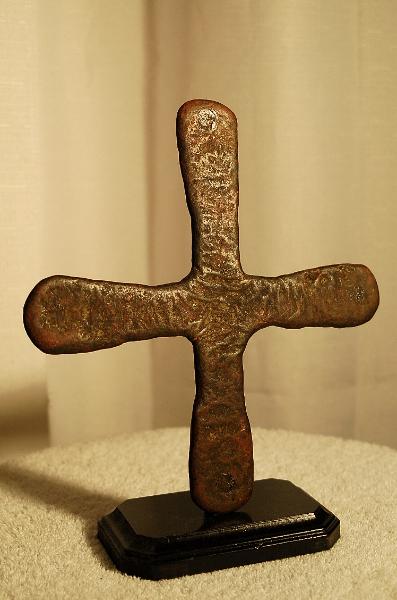
- Katanga "Cross" Currency
18 c. - 1920s
- The Katanga Cross is a primitive form of money, named after a
region in Africa along the Kasai River in Zaire . They were made
from heavy copper and have been manufactured by the indigenous
tribes for hundreds of years.
The crosses were used to buy goods when barter was not
possible. They were often used to purchase wives or slaves. A
single cross might buy 6 axes, but their principal use as currency
was in making payment of the "bride-price" or dowry - hence they
are sometimes called "wife-buying" crosses. One cross was worth
ten kilos of flour, five fowls, three kilos of rubber or six axes. A bride
price consisted of fourteen large crosses, one she-goat, one gun
and one female slave. Seven crosses would purchase a slave. The
large "coins" are known locally as "lunkana".
- Katanga is a rich copper mining region is the south-eastern portion
of Zaire. The crosses were cast by native coppersmiths. The
Katanga region declared its independence from The Congo (now
Zaire) shortly after Belgium granted the region its independence in
1960. While archaeologists believe that even unrefined lumps of
copper were used as currency because of their standard size and
value, the copper currency that possessed refined casting
techniques and artistic value were the ingots shaped as crosses.
By 1400 A.D. two distinctive types had developed. One was
shaped like an H; the other was formed like an X. The crosses were
cast directly on the ground in many sizes. The typical size was
about nine and a half inches across, with weights varying up to four
pounds. Archaeologists also believe that the larger crosses were
made first, followed by the smaller ones as the demands of
commerce rose. The crosses were accepted as trade items
throughout central Africa. They also served as a source of copper
for re-use in jewelry as well as for other currency.
- For centuries these crosses served as indications of wealth and
were used as bridewealth payments, trade, and currency. And,
since they have been found in burials, they have also been
associated with ritualization. Large crosses were convenient for
stacking in royal treasuries and for transporting to areas of heavy
demand. The Congolese regarded the non-ferrous metals --
copper, lead, and tin -- as very precious materials. Metals were a
widespread means of exchange and important in settling social
contracts, such as marriage..
Ethnic Group:
- Katanga Society
- Congo
- Copper
Deminsions:
- 9" x 7.5"
- Quiggin, Alison Hingston. A SURVEY OF PRIMITIVE
MONEY: THE BEGINNINGS OF CURRENCY. Reprint.
London: Spink & Son, 1978. p103,plate1
- Opitz, Charles J. ODD AND CURIOUS MONEY:
DESCRIPTIONS AND VALUES. Second Edition. Ocala, FL:
First Impressions Printing, 1991.
p38
Roberto Ballarini, Armi Bianche Dell'Africa Nera (Black
Africa's Traditional Arms), Africa Curio, Milano 1992.Pgs 128
p118#77